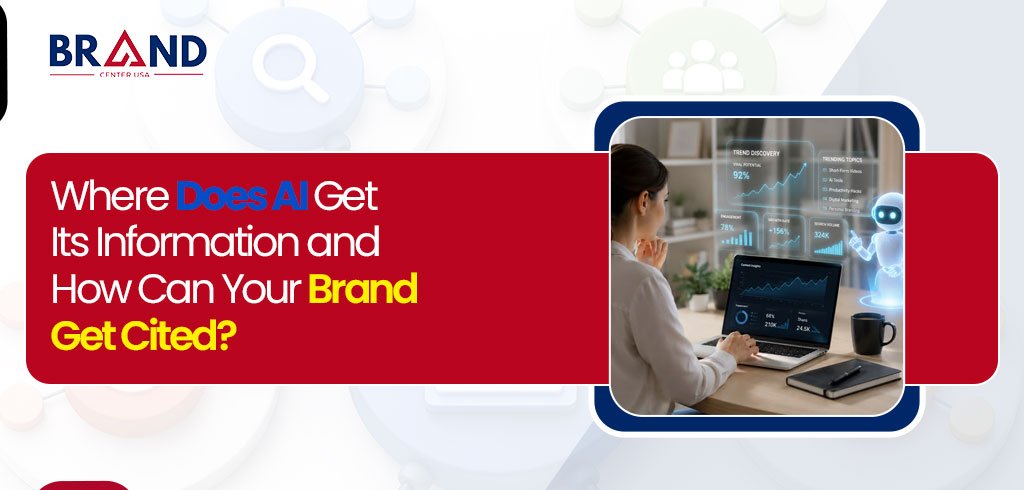
Quick Answer: Where does AI actually get its information from?
AI systems like ChatGPT, Google’s AI Overviews, Gemini, and Perplexity pull information from four main sources: the massive datasets used to train the model, live web crawling and retrieval, licensing partnerships with platforms like Reddit and Yelp, and real-time content a user submits during a conversation. Brands earn citations by making their content clear, well-structured, factually accurate, and easy for AI crawlers to access.
Search behavior has changed permanently. A growing share of buyers now ask ChatGPT, Gemini, or Google’s AI Overview a question instead of scrolling through ten blue links. For a brand, this raises a new and urgent question: if AI is answering the question before a user ever visits your website, how do you make sure your brand is the one being named? Understanding where AI gets its answers is the first step to engineering your way into them.
The Four Ways AI Systems Get Their Information
| Source | What It Means | How Brands Can Influence It |
|---|---|---|
| Training data | The historical content the model learned language and facts from | Publish authoritative, well-cited content consistently over time |
| Live web retrieval | Real-time crawling and indexing of current web pages | Keep content fresh, crawlable, and clearly structured |
| Licensing partnerships | Direct data deals, e.g., OpenAI with Reddit, Yelp, and Time | Build a genuine presence on partner platforms in your niche |
| User-submitted content | Information a user pastes or links during a live chat | Ensure your official pages are the clearest, most complete answer available |
Why This Matters More Than Traditional SEO Rankings Alone
One of the most important findings for brands to understand is that ranking on page one of Google no longer guarantees an AI citation. Research published in 2026 found that a majority of sources cited by AI answer tools are not even in Google’s top 10 organic results, which confirms that AI citation is a distinct discipline with its own signals, separate from traditional keyword ranking.
| Discipline | Goal | Primary Signal |
|---|---|---|
| SEO (Search Engine Optimization) | Rank on the search results page | Keywords, backlinks, technical health |
| AEO (Answer Engine Optimization) | Be named as the direct answer to a question | Clear, structured, question-focused content |
| GEO (Generative Engine Optimization) | Be cited as a source inside an AI-generated response | Authority signals, structured data, factual precision |
Real-World Example
A regional home-services brand ranked on page two of Google for a competitive local keyword, not strong enough to win traditional search traffic. However, because the brand’s FAQ page directly and clearly answered a specific, commonly asked question with a well-structured list and up-to-date pricing information, it began appearing as the cited source inside Google’s AI Overview for that exact query. The lesson: precise, well-structured answers can earn AI visibility even without a first-page traditional ranking.
How to Get Your Brand Cited by AI: Practical Steps
- Answer one specific question clearly per page, near the top of the content, before adding supporting detail.
- Use structured formatting, headers, bullet points, and tables, since AI models learn more easily from clearly labeled information.
- Back claims with original data, statistics, or expert commentary, since AI systems favor content demonstrating first-hand experience and authority.
- Maintain consistent brand information (name, services, location, facts) across your website and third-party listings, since inconsistency confuses AI systems building a picture of your brand.
- Build a genuine, active presence on platforms AI companies have licensing deals with, such as Reddit and industry-specific review sites.
- Publish consistently rather than sporadically, since AI platforms, especially those with live web indexes, tend to reflect newly published content within days to weeks.
EEAT and AI Citation: Why They Are Connected
Google’s Experience, Expertise, Authoritativeness, and Trustworthiness (EEAT) framework was designed for search rankings, but it maps directly onto what AI systems look for when deciding what to cite.
Content written by demonstrated experts, backed by original data or direct experience, hosted on a trustworthy and consistent domain, is exactly the type of content AI models are trained to treat as reliable enough to quote.
In practice, strengthening your EEAT signals for Google also strengthens your odds of being cited in AI Overviews, ChatGPT, and Perplexity.
Local and Voice Search Considerations
For local businesses, AI answer engines increasingly pull from a combination of your website, Google Business Profile, and review platforms. Keeping your business name, address, phone number, services, and hours consistent across all of these ensures AI systems build one accurate picture of your business rather than a fragmented or outdated one, which is especially important as voice search and conversational local queries continue to grow.
Bottom Line
AI is no longer a future consideration for brand visibility, it is a primary discovery channel today. Understanding that AI systems draw from training data, live retrieval, licensing partnerships, and user input gives brands a clear, actionable map for where to focus their efforts.
The brands that win AI citations are not always the ones ranking first on Google; they are the ones publishing clear, well-structured, consistently accurate content that answers a specific question better than anyone else.
At Brand Center USA, we build content strategies engineered for SEO, AEO, and GEO together, so your brand shows up wherever your customers are asking questions.
Want to find out exactly where AI sees your brand today, and where it doesn’t? Brand Center USA offers a free AI visibility audit covering SEO, AEO, and GEO. Visit brandcenterusa.com to claim yours.
Frequently Asked Questions
1. Can I pay to get my brand cited by AI tools like ChatGPT?
No. AI models cite based on content quality, structure, and authority signals, not advertising spend. Paid visibility on platforms AI crawlers actively index can indirectly help, but it does not buy a citation.
2. How long does it take for new content to appear in AI answers?
Timelines vary by platform: tools with live web indexes can reflect new content within days to weeks, while citation behavior tied to a model’s training cycle can take considerably longer.
3. Does my website need to rank on page one of Google to be cited by AI?
No. Studies show a large share of AI-cited sources are not in Google’s top 10 organic results, meaning strong, well-structured content can earn citations independent of traditional ranking position.
4. What is the difference between an AI mention and an AI citation?
A mention references your brand by name without a link; a citation includes a direct link or clear source reference. Both build authority, but citations also drive direct traffic.
5. Do AI systems treat all industries the same way?
No. Commercial and product-based queries tend to trigger more brand mentions, while informational queries lean more heavily on structured, question-focused content and community platforms.
6. Is structured data (schema markup) important for AI citations?
Yes. Structured data helps AI crawlers and answer engines interpret your content’s facts, entities, and context more reliably, which supports both traditional SEO and AI-driven answer engines.